Quick Answer
How much muscle you can build depends on several variables:
| Variable | What It Means | Priority |
|---|---|---|
| Volume | Hard sets per muscle per week | Highest |
| Progressive overload | Increasing the training stimulus and challenge over time | Highest |
| Intensity (effort) | How close to failure each set is performed | High |
| Frequency | How often each muscle is trained per week | High |
| Exercise selection | Choosing exercises that match muscle function | Moderate |
| Rep range | Number of repetitions per set | Moderate |
| Rest periods | How long you rest between sets | Moderate |
How Muscle Growth Actually Works
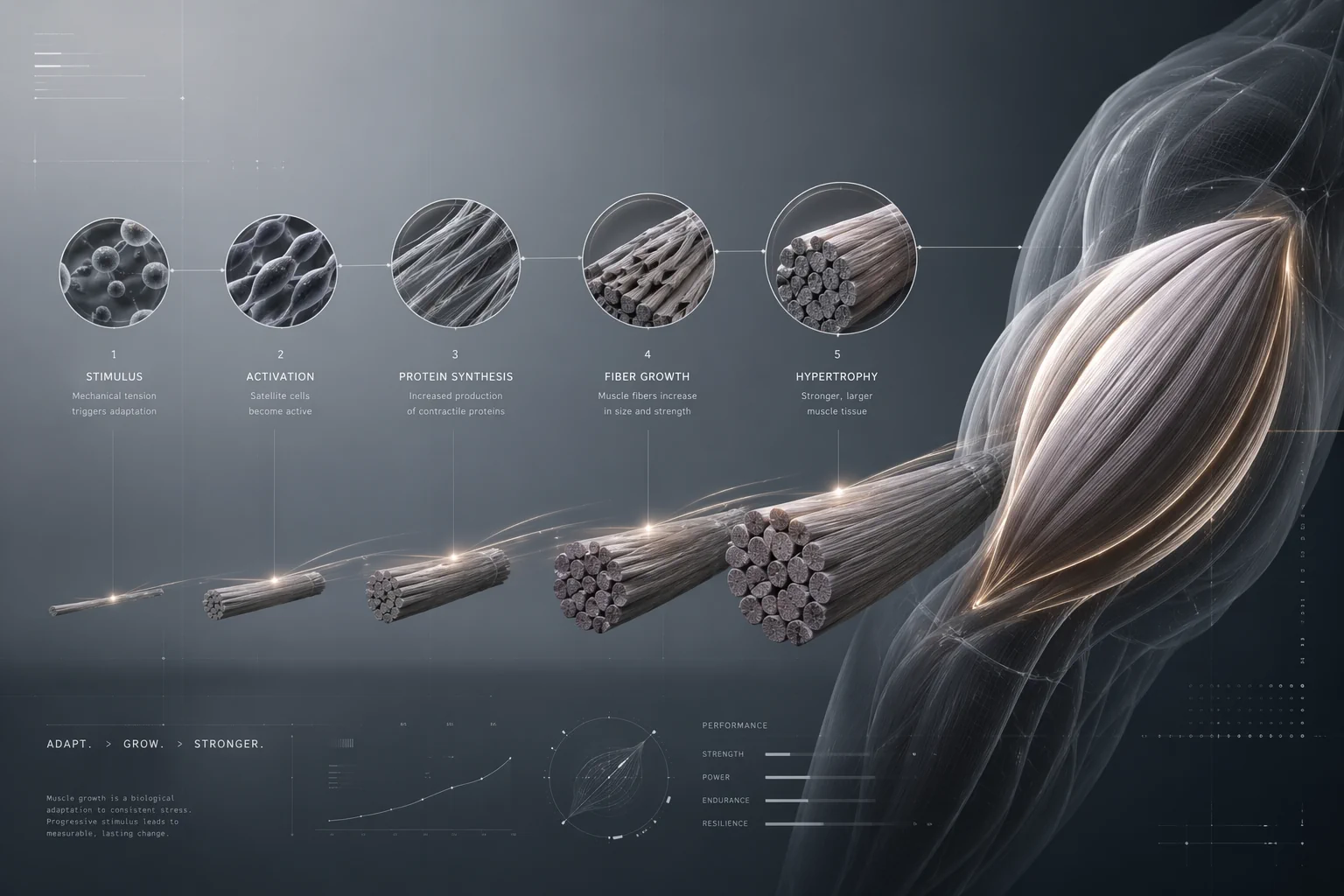
Muscle hypertrophy is when the muscle grows bigger because of an increase in muscle fiber cross-sectional area. It occurs from mechanical tension during resistance training, which triggers a cascade of intracellular signals.
This process is called mechanotransduction. It activates satellite cells and anabolic pathways that ramp up muscle protein synthesis. Over time, if protein synthesis consistently exceeds protein breakdown, the muscle grows.
Mechanical tension is the most important driver of hypertrophy. It is created when you lift weights with sufficient load (weight) and effort (proximity to failure).
Research also points to metabolic stress (the "burn" from high-rep work) and muscle damage as secondary contributors, but their independent roles remain debated. However, current evidence suggests they don't add much to growth when mechanical tension is already optimized.
Training Volume
Training volume is simply how much total work you do for a muscle each week. Researchers typically count it as the number of hard sets per week. It's one of the biggest drivers of muscle growth. Indeed, more volume generally means more growth, up to an individual ceiling.
1 Research shows a clear dose-response relationship: higher weekly set counts consistently produce greater muscle growth than lower ones, at least up to a point. The relationship is real but not linear. Going from 4 to 8 sets per week produces a bigger jump in growth than going from 16 to 20.
Here is the recommended volume based on your experience level:
| Experience Level | Sets per Muscle / Week | Notes |
|---|---|---|
| Beginner (< 1 year) | 6-8 | Your nervous system is still adapting, which means even small amounts of training produce big results |
| Intermediate (1-3 years) | 8-12 | Gradually increase volume each training block |
| Advanced (3+ years) | 12-20 | Individual variation is high; the upper end is only for those who recover well |
Training Intensity (Effort Level)
In exercise science, "intensity" technically refers to load as a percentage of your one-rep maximum. However, in the hypertrophy literature, the word is often used to mean proximity to failure (how close to your limit each set is taken). Both meanings are correct, but we'll discuss about the latter in this article.
The measure used here is Reps in Reserve (RIR): the number of additional reps you could have completed at the end of a set with strict form. A set ending at 2 RIR means you stopped when you had roughly two good reps remaining.
2 Training close to failure is necessary to fully recruit high-threshold motor units. These are the fast-twitch fibers with the greatest growth potential. A 2021 systematic review and meta-analysis found that training to complete failure does not provide additional hypertrophy gains over having 1-3 reps in reserve, when total volume is equated. We should also note that most studies in this area are short-term (8-12 weeks), so the long-term tradeoffs of chronic failure training, particularly on joint health and recovery, are not well established. The practical conclusion is that stopping at 1-3 RIR maximizes the stimulus while avoiding the high central nervous system fatigue that comes with sets to complete failure.
| RIR | Description | Hypertrophy Stimulus | Recommendation |
|---|---|---|---|
| 0 RIR (failure) | Cannot complete another rep | Maximal | Use with moderation: high fatigue cost |
| 1-2 RIR | One or two reps left in the tank | Very high | Ideal for most work sets |
| 3 RIR | Three reps remaining | Good | Acceptable, especially for compound lifts |
| 4-5 RIR | Comfortable, moderate effort | Moderate | Only suitable for warm-up sets |
| 6+ RIR | Easy, little challenge | Low | Ineffective for hypertrophy |
Training Frequency
Frequency describes how many times per week a given muscle group is trained. It matters primarily because it affects how efficiently you can distribute your weekly volume.
3 A 2016 meta-analysis found that training a muscle at least twice per week produced greater hypertrophy than once per week, when total weekly volume was equated. However, the effect size was modest. The most logical explanation is that spreading volume across sessions allows each session to be performed with higher quality. Indeed, we have less accumulated fatigue per session, better technique, and greater mechanical output.
| Frequency | Hypertrophy Outcome | Best Suited For | Common Split |
|---|---|---|---|
| 1x per week | Suboptimal | Complete beginners or low-volume phases | "Bro split" (chest day, back day, etc.) |
| 2x per week | Optimal | Most lifters at all experience levels | Upper/lower, Push/pull/legs |
| 3x per week | Optimal | Advanced lifters with high volume tolerance | Full-body 3x or PPL 6-day |
| 4+x per week | Specialized | Lagging muscle groups; specialized phases | High-frequency specialization blocks |
Note that frequency alone does not determine growth; it is a tool for managing volume effectively. Training a muscle three times per week with 5 sets per session (15 sets total) is roughly equivalent to twice per week at 7-8 sets per session.
Repetition Range
A common myth is that you must train in a specific rep range (like 8-12 reps) to build muscle.
4 In reality, muscle growth can occur across a very wide range of repetitions. The main requirement, however, is that sets need to be taken close to failure. If a set is too easy, it will not stimulate much growth regardless of the rep range.
| Rep Range | Load (% 1RM) | Hypertrophy | Strength | Practical Notes |
|---|---|---|---|---|
| 1-4 reps | >90% | Moderate | Very high | High injury risk; best left for powerlifting-specific phases |
| 5-8 reps | 78-87% | High | High | Great for compound lifts (squat, bench, row); builds strength and muscle |
| 8-15 reps | 65-77% | High | Moderate | The classic bodybuilding range; good balance of stimulus and fatigue |
| 15-30 reps | 50-64% | High | Low | Effective when close to failure; causes more metabolic fatigue than neural; good for isolation work |
| 30+ reps | <50% | Moderate | Very low | Diminishing returns; useful for blood flow restriction (BFR) training |
Progressive Overload
The most important principle in resistance training is probably progressive overload. It means that the training stimulus must increase in order for the body to continue adapting. Without it, the body reaches a plateau and muscle growth stalls, even if volume, intensity, and frequency are optimal.
The simplest form is adding weight to the bar. But there are several ways to apply it, and smart programs cycle between them:
| Method | How It Works | Best Applied To |
|---|---|---|
| Load progression | Add weight to the bar when the top of your rep range is reached (e.g., add 2.5 kg when you hit 12 reps) | Compound lifts; beginners and intermediates |
| Rep progression | Perform more reps with the same weight before increasing load | Isolation exercises; when load jumps are too large |
| Set progression | Gradually add sets per week across a training block (e.g., 12 → 15 → 18 sets/week) | Intermediate and advanced lifters during volume phases |
| Technique improvement | Better range of motion or muscle activation with the same load | Beginners; learning new exercises |
Rest Periods
How long you rest between sets is something many people don't pay attention to. However, rest periods have a huge impact on training quality.
A very common belief is that shorter rest times keep your heart rate up, which creates a better "pump", and therefore builds more muscle. However, the research tells a different story.
5 Research has shown that longer rest periods (2-3 minutes or more) generally produce greater muscle growth than shorter ones (60-90 seconds). Researchers explain this because they allow more complete phosphocreatine resynthesis and reduce accumulated fatigue, which enables better performance in future sets.
| Rest Duration | Use Case | Effect on Performance | Hypertrophy |
|---|---|---|---|
| < 60 s | Supersets, circuits, conditioning | Significantly reduced | Suboptimal |
| 60-90 s | Isolation exercises, high-rep work | Moderately reduced | Moderate |
| 2-3 min | Most hypertrophy work sets | Largely recovered | Good |
| 3-5 min | Heavy compound lifts (squat, deadlift) | Fully recovered | Optimal for strength lifts |
To sum it up, you shouldn't rush your rest periods because you believe that shorter rest increases "metabolic stress" and therefore growth. The small benefit of metabolic stress is less important than the cost of worse performance in the following sets.
Exercise Selection
While any resistance exercise can stimulate muscle growth, some exercises provide a better stimulus for specific muscles than others. A well-designed program uses compound (multi-joint) lifts as a foundation and supplements them with isolation exercises to address specific muscles or correct imbalances.
| Category | Examples | Pros | Cons |
|---|---|---|---|
| Compound lifts | Squat, bench press, deadlift, overhead press, row | Train multiple muscles simultaneously; allow heavy loading; time-efficient | Higher fatigue; harder to target a specific muscle in isolation |
| Isolation exercises | Bicep curl, lateral raise, leg extension, cable fly | Direct stimulus to a single muscle; lower systemic fatigue; good for lagging muscles | Lower overall stimulus per set; limited strength carryover |
| Machine exercises | Leg press, chest fly machine, cable row | Safer for high-rep work; useful for beginners; joint-friendly | Less functional carryover; may not fit all body proportions |
Nutrition Basics
Training is only one side of the equation. Without sufficient nutrition, especially protein and calories, muscle growth cannot occur regardless of how optimal your training program is.
| Nutrient | Target | Key Role | Example Sources |
|---|---|---|---|
| Protein | 1.6-2.2 g / kg bodyweight / day 6 | Provides amino acids for muscle protein synthesis: the most critical dietary factor for hypertrophy | Chicken, eggs, fish, Greek yogurt, whey, legumes |
| Total calories | Slight surplus (~250-500 kcal above maintenance) for muscle gain; deficit for fat loss | Energy availability; a calorie deficit limits muscle protein synthesis even when protein is adequate | All whole foods |
| Carbohydrates | 3-5 g / kg / day (more for high-volume training) | Primary fuel for resistance training; replenishes glycogen; supports training performance | Rice, oats, potato, pasta, fruit |
| Fats | 0.8-1.2 g / kg / day minimum | Hormonal health (including testosterone production); essential fatty acids; fat-soluble vitamins | Olive oil, nuts, avocado, fatty fish |
Summary Table
| Variable | Optimal Range | Key Principle | Common Mistake |
|---|---|---|---|
| Volume | 10-20 sets / muscle / week (for intermediate and advanced lifters, beginners need less) | Main driver of hypertrophy; increase gradually | Too much too soon → overtraining |
| Intensity (effort) | 1-3 RIR per set | Must be close to failure to recruit high-threshold fibers | Stopping too far from failure; sets feel comfortable but aren't effective |
| Frequency | 2x per muscle / week | Better quality volume distribution | Sticking to a classic "bro split" without enough frequency |
| Rep range | 5-30 reps | Wide range works if effort is high enough | Believing only 8-12 reps builds muscle |
| Progressive overload | Consistent increase over weeks/months | Required to force continued adaptation | Using the same weight and reps for months |
| Rest periods | 2-3 min (compound), 1-2 min (isolation) | Adequate rest preserves performance across sets | Rushing rest to "feel the burn" compromises set quality |
| Protein intake | 1.6-2.2 g / kg / day | No protein surplus = suboptimal growth, regardless of training | Underestimating daily protein needs |
If You Like Science and Studies…
1 Schoenfeld et al. (2017) performed a meta-analysis on the relationship between weekly training volume and muscle growth. They found a clear dose-response: higher volumes (10+ sets per muscle per week) consistently produced greater hypertrophy compared to lower volumes. View study →
2 Grgic et al. (2021) conducted a systematic review and meta-analysis examining training to failure. They concluded that training close to failure is sufficient for maximizing hypertrophy, and reaching absolute failure does not provide additional benefits when volume is equated. View study →
3 Schoenfeld et al. (2016) conducted a meta-analysis on training frequency and found that training muscles at least twice per week led to greater hypertrophy than once per week when total weekly volume was equated. View study →
4 Schoenfeld et al. (2017) compared low-load and high-load resistance training and found similar hypertrophy outcomes when sets were performed close to failure, confirming that a wide range of repetition schemes can be effective. View study →
5 Schoenfeld et al. (2016) compared short (1-minute) versus long (3-minute) rest intervals and found that longer rest periods resulted in significantly greater increases in muscle thickness and strength. View study →
6 Morton et al. (2018) performed a systematic review and meta-analysis on protein intake and resistance training. They found that the mean threshold at which muscle growth plateaus is around ~1.6 g/kg/day. However, the upper 95% confidence interval of their data extends to ~2.2 g/kg/day, meaning individual needs vary. Targeting 1.6-2.2 g/kg/day provides a practical buffer that ensures most people comfortably meet their threshold. View study →
References
1 Schoenfeld BJ, Ogborn D, Krieger JW. Dose-response relationship between weekly resistance training volume and increases in muscle mass: a systematic review and meta-analysis. J Sports Sci. 2017;35(11):1073-1082.
2 Grgic J, Schoenfeld BJ, Orazem J, Sabol F. Effects of resistance training performed to failure or not to failure on muscular strength and hypertrophy: a systematic review and meta-analysis. J Sport Health Sci. 2021;10(2):202-211.
3 Schoenfeld BJ, Ogborn D, Krieger JW. Effects of resistance training frequency on measures of muscle hypertrophy: a systematic review and meta-analysis. Sports Med. 2016;46(11):1689-1697.
4 Schoenfeld BJ, Grgic J, Ogborn D, Krieger JW. Strength and hypertrophy adaptations between low- vs. high-load resistance training: a systematic review and meta-analysis. J Strength Cond Res. 2017;31(12):3508-3523.
5 Schoenfeld BJ, et al. Longer inter-set rest periods enhance muscle strength and hypertrophy in resistance-trained men. J Strength Cond Res. 2016;30(7):1805-1812.
6 Morton RW, et al. A systematic review, meta-analysis and meta-regression of the effect of protein supplementation on resistance training-induced gains in muscle mass and strength. Br J Sports Med. 2018;52(6):376-384.